
The Future of Skincare Is Smarter Than Your Bathroom Mirror
Imagine completing an assignment on machine learning and then, right from the same device, having that same technology analyze your skin in under three seconds. That is no longer science fiction.
AI-powered tools are rapidly entering spaces we never expected—from diagnosing disease to recommending moisturizers. For students studying technology, health sciences, digital innovation, or marketing, understanding how these tools work is becoming part of a well-rounded education.
One app that stands out as a real-world case study of applied AI is Smart Beauty, developed by tech company Bluesense AI. It is not just a skincare tool; it is a compelling example of how computer vision, machine learning, and health data come together in a consumer application.
Let us break it down.
What Is Smart Beauty? A Real-World AI Case Study
Smart Beauty is an all-in-one personal skincare consultant powered by artificial intelligence. Built by Bluesense AI Inc., a Vancouver-based technology company headquartered at the Simon Fraser University Charles Chang Innovation Centre, the app is designed to help users understand their skin and monitor visible changes over time.
For students of AI, health tech, or digital product design, Smart Beauty is a textbook example of what happens when theoretical AI concepts are applied to solve real human problems.
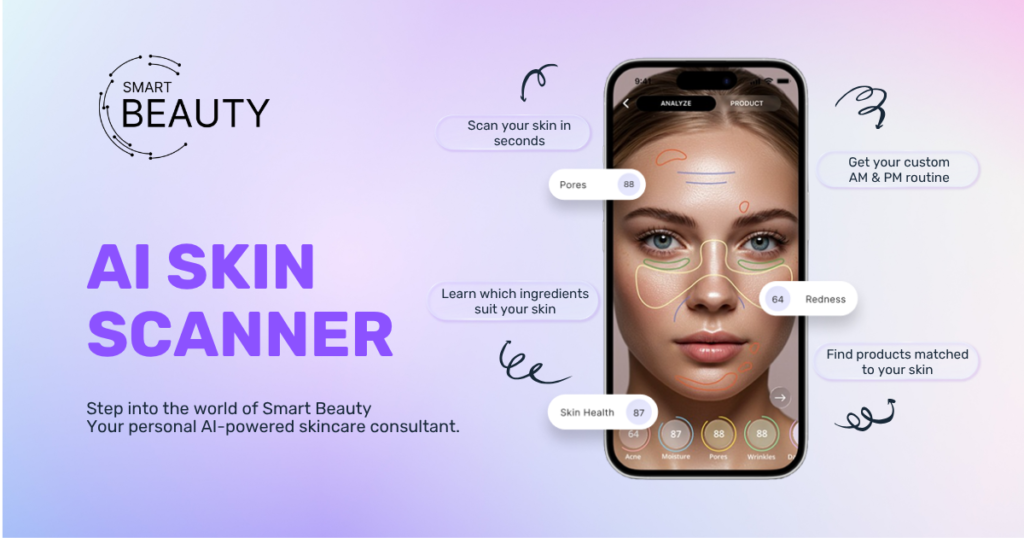
The app uses computer vision and machine learning to analyze a selfie and generate personalized skincare recommendations. It assesses skin type, texture, hydration levels, and specific concerns, then delivers a detailed, data-driven report in seconds.
The Technology Behind It: A 16-Point AI Skin Analysis
Most apps that claim to use AI apply it at a surface level. Smart Beauty goes significantly deeper. Its advanced AI model evaluates 16 distinct skin factors:
Acne & Blemishes
Moisture & Hydration
Pores & Texture
Wrinkles & Firmness
Dark circles & Eyebags
Redness & Spots
Eyelids
Radiance
UV damage
Oiliness
Skin tone evenness
This kind of multi-variable analysis is a practical application of what computer science students study in courses on image classification, feature extraction, and convolutional neural networks (CNNs).
The process is entirely frictionless for the end-user. Snap a selfie, let the algorithm run, and within seconds you receive a detailed map of your skin’s current health. No dermatologist waitlist, no expensive consultation—just data-driven insight available around the clock.
Did You Know? Bluesense AI’s broader portfolio also includes early detection capabilities for 14 skin conditions, including certain types of skin cancer. This means the technology underpinning Smart Beauty is built on infrastructure designed to support real medical awareness, not just cosmetic grading.
Key Features That Demonstrate AI in Action
1. Personalized Product Recommendations
Smart Beauty provides AI-driven suggestions for serums, moisturizers, sunscreens, and targeted treatments. Users can browse and buy directly in-app from top dermatological brands, complete with ingredient breakdowns.
Educational Angle: This is a live example of a recommendation engine—the same type of algorithm that powers Netflix suggestions or Amazon’s “you may also like” feature—applied directly to skincare chemistry.
2. AI Skincare Chatbot
Users can ask skincare questions around the clock and receive instant, expert-level advice, ranging from “Which serum suits my oily T-zone?” to “Can I layer retinol with vitamin C?”
Educational Angle: This is natural language processing (NLP) applied to a domain-specific knowledge base, a concept studied deeply in AI, linguistics, and information science courses.
3. Routine Tracking and Progress Reports
The app includes before-and-after galleries, customizable reminders, and weekly performance reports to help users track their skin’s transformation over time.
Educational Angle: Longitudinal data tracking and behavioral nudge design sit at the intersection of UX design, data science, and behavioral psychology.
4. Dermatologist Access
When AI reaches its limits, Smart Beauty connects users with real dermatologists, recognizing that human expertise remains essential in health-adjacent AI applications.
Educational Angle: This reflects the critical ethical principle of knowing when to escalate to human oversight, a topic covered heavily in AI ethics and human-computer interaction (HCI) courses.
Why This Matters for Learners
The Democratization of Expert Knowledge
Historically, understanding your skin required a dermatologist appointment, out-of-pocket costs, and weeks of waiting. Smart Beauty compresses that experience into a three-second scan. For students in public health or social sciences, this raises important questions: What does it mean for equity when a smartphone can deliver advice previously only available to those with financial means and geographic access?
Privacy-First AI Design
Smart Beauty has made deliberate architectural choices around data privacy:
Photos are transmitted securely to Bluesense’s servers.
Data is encrypted both in transit and at rest.
Images are retained only long enough to generate the skin report, and are then permanently deleted.
Images are never shared with third parties.
For students studying cybersecurity or data governance, this is an excellent model worth examining in a landscape often criticized for opaque data practices.
Global Accessibility Through Language Support
The platform supports 49 languages (including Russian and Arabic) alongside continuously improved skin analysis accuracy. For students in international development or globalization studies, this speaks directly to the intentional design of inclusive technology.
Key Takeaways for Students and Learners
Real AI is multidisciplinary: Smart Beauty combines computer vision, machine learning, NLP, dermatology, and UX design. No single discipline owns it.
User trust must be earned through design: The app’s privacy architecture is not an afterthought; it is a core feature.
AI does not replace human expertise: It extends access to it. The in-app dermatologist connection reflects a thoughtful, responsible approach to health-adjacent tech.
Accessibility is good product design: Supporting 49 languages is a definitive statement of intent toward global inclusion.
Try It Yourself
Whether you are a student looking for a concrete AI case study, a health science learner curious about diagnostic technology, or simply someone tired of buying the wrong moisturizer, this platform is worth your attention.
Smart Beauty is available for iOS and Android. Discover the technology firsthand and explore the platform at Smart Beauty App.